
AI Adoption vs. AI Governance: The Difference and a Practical Checklist


A company launches an AI assistant, buys enterprise chatbot licenses, and encourages staff to automate repetitive work. Within months, usage rises and teams report saving time. Has the company become an AI-mature organization? Not necessarily. It has demonstrated AI adoption, but it may still lack the mechanisms to understand, control and justify how those systems operate.
That distinction matters more as artificial intelligence moves from answering questions to retrieving confidential records, generating software and executing actions. Adoption measures the spread and usefulness of AI. Governance establishes who is accountable, which uses are permitted, how risks are assessed, and what evidence shows that controls are working. One creates capability; the other makes capability manageable.
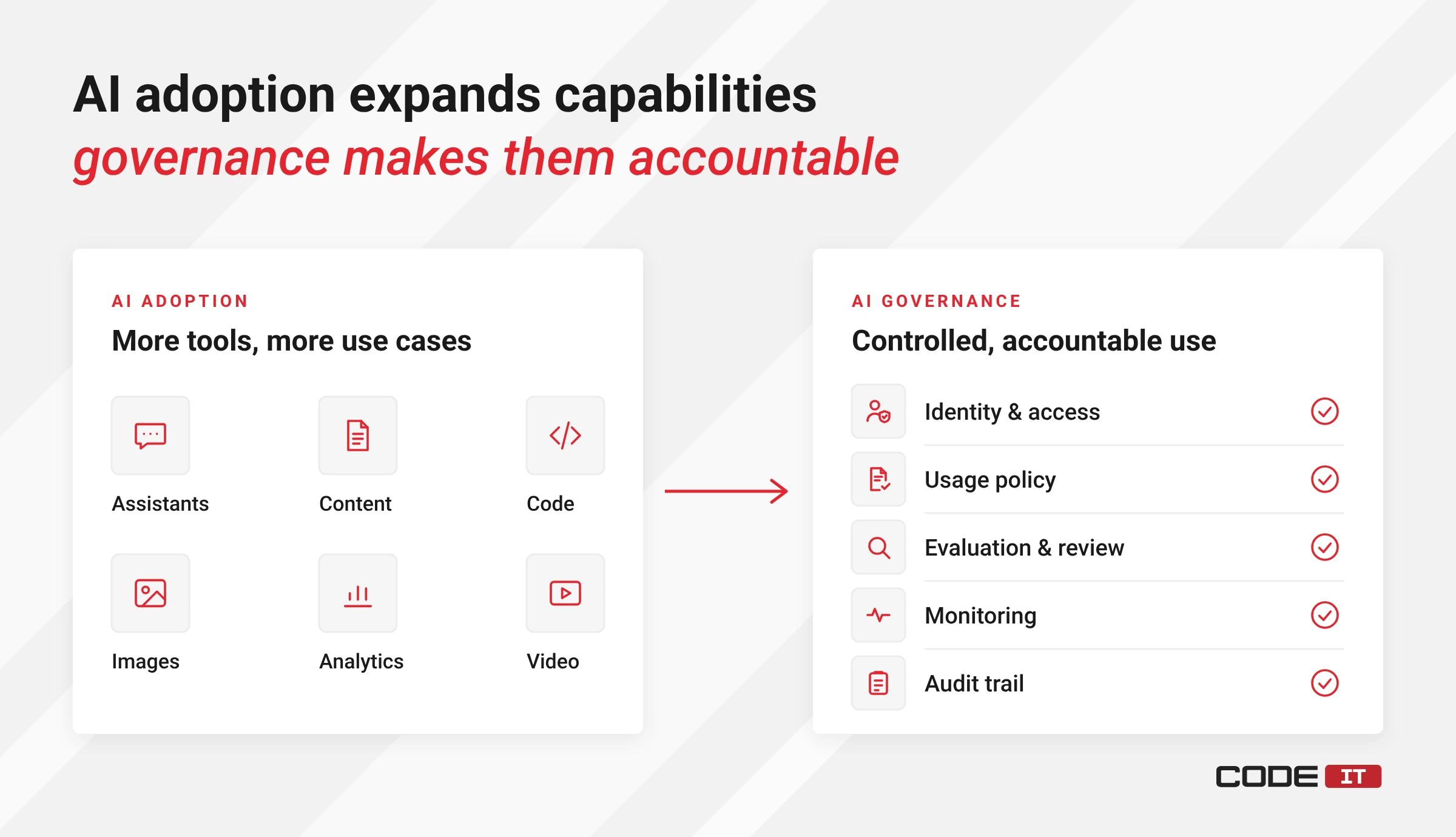
The Adoption-Governance Gap Is Measurable
McKinsey’s 2026 State of AI survey found that 44% of respondents reported AI scaling across their enterprise, up from 38% a year earlier. Yet 37% reported that AI has contributed positively to their organization’s EBIT, essentially unchanged from 2025. These are self-reported survey results, not proof that governance caused or prevented returns. They nevertheless illustrate why deployment and business impact must be measured separately, a point we also cover in our guide to AI ROI.
There is an equally important control gap. In IBM’s 2025 Cost of a Data Breach study, which covered 600 breached organizations, 63% either had no AI governance policy or were still developing one. IBM also found that 97% of the organizations that reported breaches of AI models or applications (13% of the sample) lacked proper AI access controls. Because the sample consists of organizations that experienced breaches, these figures should not be generalized to all businesses.
They do point to a common AI governance challenge: employees can gain access to models faster than organizations establish an inventory, risk ownership and operating controls. Shadow AI is the visible result.
What Is AI Adoption?
Adoption is the organizational process of moving AI from experimentation into everyday workflows. It covers selecting vendors and models, connecting relevant data, training employees, redesigning processes, and measuring whether the result improves speed, quality, cost or customer outcomes.
For a customer-support assistant, adoption metrics might include weekly active users, the percentage of queries assisted, resolution time, cost per case and customer satisfaction. Those metrics reveal whether people use the system and whether the workflow improves. They do not reveal whether the assistant accessed information it should not have seen, fabricated a policy, or acted with excessive permissions.
A successful pilot can therefore be a weak production system. A small test may use curated documents and motivated users; the deployed system encounters conflicting sources, adversarial inputs, model updates, outages and unexpected edge cases. This is one reason many projects stall after the pilot, as we describe in why enterprise AI projects fail. Adoption is necessary for value, but it does not by itself establish a safe operating envelope.
What Is AI Governance?
AI governance is the collection of decision rights, policies, technical safeguards and evidence used to direct and oversee AI throughout its lifecycle. It applies to purchased assistants, internally developed models, retrieval-augmented generation (RAG) applications and autonomous agents, not only to teams training foundation models.
Two widely used AI governance frameworks give the structure. The US National Institute of Standards and Technology organizes AI risk management into four functions: Govern, Map, Measure and Manage. Governance is cross-cutting: organizations define accountability, understand each system’s context, evaluate risks, and respond as conditions change. The NIST AI Risk Management Framework is voluntary guidance, not a certification or law.
ISO/IEC 42001:2023 takes a management-system approach. It specifies requirements for establishing and continually improving an AI management system, including the processes by which an organization manages AI-related responsibilities and risks. ISO 42001 can support a structured governance program, but implementing it does not automatically satisfy every applicable legal obligation.
Good governance asks concrete questions:
- What is this system authorized to do?
- Which data may it process?
- What level of error or risk is acceptable?
- Who approves deployment and material changes?
- Who investigates incidents and can suspend operation?
- What evidence shows that the controls work?
For the identity, data and action-level controls in detail, see our guide to enterprise AI governance.
AI Adoption vs. AI Governance: Key Differences
| Dimension | AI adoption | AI governance |
| Primary question | Is AI creating business value? | Is AI operating within acceptable boundaries? |
| Focus | Usage, productivity, outcomes | Accountability, risk, controls, evidence |
| Ownership | Business and product teams | Shared across business, engineering, security and risk |
| Success indicators | Adoption rate, quality, efficiency, ROI | Control coverage, incidents, exceptions, compliance |
| Typical activities | Pilots, integration, training, workflow redesign | Risk review, access controls, approval gates, monitoring |
| Main risk when missing | Underused technology and unrealized value | Uncontrolled data exposure and operational risk |
Both disciplines are necessary. Governance does not replace adoption work, and adoption success does not replace governance.
The Technical Difference Lives in the Architecture
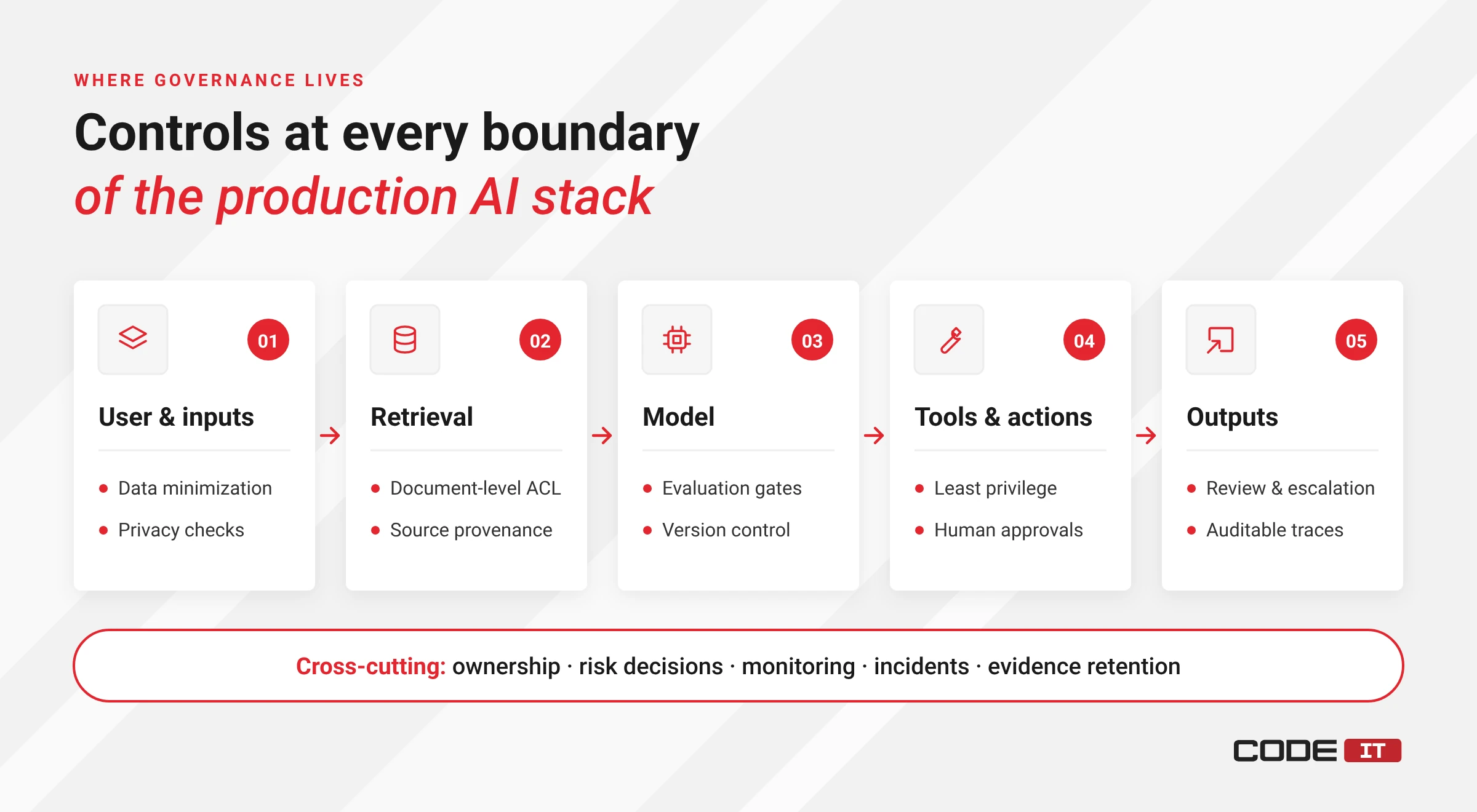
Consider a RAG assistant connected to an internal knowledge base. Adoption connects a model to documents and puts a chat interface in front of employees. Governance adds controls at every boundary.
At ingestion, documents need ownership, classification, retention rules, and checks against importing confidential content into inappropriate environments. At retrieval, authorization must be enforced using the requesting user’s permissions; hiding a document in the interface is not equivalent to preventing retrieval. Sensitive fields may require minimization or redaction before they reach a model. Skipping these steps is one of the main routes to AI data leakage.
At the model layer, teams should maintain versioned prompts and configurations, evaluate answers against representative test cases, measure citation or factual accuracy where feasible, and retest after model or knowledge-base changes. Human review, calibrated refusal or escalation paths may be necessary when an incorrect answer could cause material harm. NIST’s generative AI profile explicitly identifies confident false outputs, or confabulation, as a risk.
At the tool layer, agents require least-privilege identities, allow-listed operations, scoped credentials, and approval before consequential actions such as changing payments or deleting records. The OWASP Top 10 for LLM Applications (2025) identifies prompt injection, sensitive-information disclosure and excessive agency among the major risks. A prompt telling a model to behave safely cannot replace an authorization check enforced by software.
Finally, production systems need structured logs, privacy-aware traceability, incident-response procedures, rate limits, cost budgets and monitoring for quality degradation. Where appropriate, logs should record model and prompt versions, retrieval sources, tool calls, reviewer decisions and policy outcomes, without unnecessarily storing personal data. Governance makes the AI system observable and interruptible, not just accessible. It cannot live only in a policy document; it has to be reflected in how the system is designed, operated and monitored.
A Practical Example: The HR Assistant
Imagine an HR team deploying an AI assistant to summarize employee policies and prepare draft answers. An adoption-only project measures employee uptake and time saved. It might also connect the assistant to the entire HR document repository for convenience.
A governed version starts by restricting the use case to approved policy questions. Retrieval respects document-level access; payroll and medical files remain outside scope. Outputs cite source policies, uncertain answers escalate to HR, and the assistant cannot modify an employee record. The system owner reviews evaluation results after content updates, while the security team tests for malicious instructions embedded in retrieved files.
The second system may have a narrower feature set initially. But it has a defined purpose, accountable ownership, documented controls and a safer path to expansion. Governance does not oppose innovation; it lets useful innovation survive contact with real operational risk.

Not sure which of your AI tools are governed and which are only adopted?
AI Governance Checklist: Five Steps From Policy to Operating Model
Implementing AI governance does not require a large bureaucracy. It requires an AI governance policy and an operating model with safeguards proportionate to the risks each AI system creates. This AI governance checklist is a practical starting point.
1. Build an AI inventory
Record the AI systems and capabilities used across the organization, including embedded AI features and employee-discovered tools. Capture each system’s owner, vendor or model, business purpose, users, data sources, integrations, and whether it can take actions. Do not rely on procurement records alone: browser extensions, personal accounts, SaaS features and connected agents can introduce AI without a purchasing decision. Our guide to detecting shadow AI covers discovery methods.
Expected output: an AI system register with named owners, use cases, data sources and integrations.
2. Tier use cases by risk
A drafting aid has a different risk profile from a credit decision, a recruitment screening system, or an agent authorized to move money. Classify use cases by possible harm, data sensitivity, autonomy, affected groups and legal duties, and apply more scrutiny where consequences are greater.
Expected output: a documented risk classification and review requirements for each use case.
3. Define approval and release gates
Before deployment, define what a system must demonstrate to be approved. Depending on risk, that may include privacy and security review, evaluation thresholds, adversarial testing, fallback behavior and human oversight. Material changes to the model, integrations, data access or permitted actions should trigger reassessment, and accepted residual risks should have a named owner.
Expected output: an approval record with evaluation results, outstanding risks and the deployment decision.
4. Enforce controls in code
Use identity and access management, scoped tool permissions, data-loss prevention where appropriate, audit trails, rate limits, and human approval for high-impact actions. For agents, authorization must be enforced independently of the instructions the model generates. A slide deck cannot enforce least privilege.
Expected output: implemented safeguards, with evidence that the controls were tested.
5. Monitor and reassess
Track incidents, failed checks, policy exceptions, access-control violations, performance by relevant user group, vendor and model revisions, and costs. Define review intervals and a fast way to suspend unsafe features, and use the results to adjust permissions, evaluations and risk tiers.
Expected output: a recurring review process with monitoring evidence, remediation owners and documented decisions.
A useful division of responsibility is clear: business owners justify the use case, engineering implements safeguards, security and privacy specialists review exposure, and risk or compliance teams maintain oversight. Senior leadership owns the risk appetite and the escalation path.
AI governance quick checklist: is your organization ready?
Use these questions as a preliminary self-check.
☐ AI visibility: Do we maintain an inventory of AI tools, applications, embedded features and agents?
☐ Accountability: Does every AI system have a named business owner?
☐ Risk classification: Are AI use cases classified by potential business, security, privacy and legal impact?
☐ Approval process: Do higher-risk AI systems require documented review before deployment?
☐ Data protection: Are restrictions on sensitive data access and processing enforced technically?
☐ Agent permissions: Are AI agents limited to approved tools, actions and authorization scopes?
☐ Monitoring: Can we investigate AI-related incidents, access violations and consequential tool actions?
☐ Continuous review: Are AI systems reassessed after material changes to models, data sources, integrations or permissions?
Each unchecked item marks an area that needs review. A checked answer should be backed by evidence, not by a policy statement alone, and some controls will not apply to every use case. This list is a starting point, not a formal maturity assessment or a compliance determination.
Regulation and the Evidence Question
Governance also supports compliance, but the two are not identical. The EU AI Act follows a risk-based model and applies different obligations to different actors and systems. The European Commission began enforcing the Act on 2 August 2026, covering rules for general-purpose AI model providers, transparency obligations and prohibited practices. Under the Digital Omnibus, which entered into force on 27 July 2026, obligations for stand-alone high-risk systems listed in Annex III apply from 2 December 2027, and for high-risk AI embedded in regulated products from 2 August 2028. Exact obligations depend on the system and on the organization’s role as provider, deployer or another regulated actor.
Rather than treating compliance as a one-time checklist, teams should maintain evidence: system inventories with accountable owners, risk and impact assessments, evaluation and security test results, human-oversight and escalation procedures, change approvals and accepted risks, and monitoring and incident records. Even where a specific regulation does not apply, these records make internal accountability possible.
How to Measure AI Adoption and Governance Separately
Leadership needs two views. The adoption dashboard answers whether AI is used and whether it improves business outcomes. The governance dashboard answers whether the organization understands and manages the risks of that use.
| AI adoption metrics | AI governance metrics |
| Active AI users | Share of AI systems inventoried |
| Workflow adoption rate | Share of systems with a named owner |
| Time saved per workflow | Share of higher-risk use cases reviewed before deployment |
| Productivity and quality improvement | Evaluation and control-test pass rates |
| Cost per transaction or process | Access-control violations and policy exceptions |
| AI-attributable business impact, net of model, integration and oversight costs | Time to remediate findings and incidents |
Neither view is sufficient alone, and the two should not be collapsed into a single maturity score. High usage with weak controls creates hidden exposure; immaculate paperwork around an unused tool creates little value. The objective is controlled expansion: systems that solve real problems and continue to behave within clear operational limits. Our AI strategy guide shows how to connect both views to business priorities.
Conclusion
AI adoption answers, “Can we use this technology productively?” AI governance answers, “Can we demonstrate that it is used appropriately, safely and under accountable control?” Mature organizations treat these as parallel disciplines. They experiment quickly, but they inventory what they deploy. They improve workflows, but they test failure modes. And they scale only when ownership, safeguards and monitoring can scale with them.
FAQ