
Security Assessment Services
We find the security gaps that actually matter — in your applications, infrastructure, processes, and AI usage — and stay with you until they’re fixed.

Business First
Code Next
Let’s talk
Why companies come to us
“Are we exposed right now?”
Attackers weaponize new vulnerabilities within 48 hours. Point-in-time checks can’t keep up.
Our offensive security services find and validate the weaknesses a real attacker would exploit — once, or continuously.
Penetration Testing · Infrastructure Security Audit · Continuous Threat Exposure Management
“Can we prove we’re secure?”
Regulators, auditors, and enterprise customers all want evidence.
Our governance and audit services show where you stand against ISO 27001, SOC 2, NIS2, DORA, and GDPR — and give you a prioritized roadmap to get there.
Company Security Audit · Secure AI Usage Audit
“Is our AI usage safe?”
Your team is already using AI — with or without a policy.
We assess how AI is used across your company and how your own AI systems are secured, before data leakage catches you off guard.
Secure AI Usage Audit · LLM Security Audit
Our services
Penetration Testing Services
Penetration testing that thinks like an attacker — because it’s done by humans, not scanners.
Continuous Threat Exposure Management (CTEM)
Attackers don’t work annually. Neither should your security testing.
Infrastructure & Cloud Security Audit
Your business runs on your infrastructure. Let’s make sure attackers can’t.
Company Security Audit
The honest answer to “how secure are we, really?”
Secure AI Usage Audit
Your employees are already using AI. Do you know what they’re sharing with it?
LLM & AI System Security Audit
You deployed a private LLM to keep your data safe. Is the LLM itself safe?
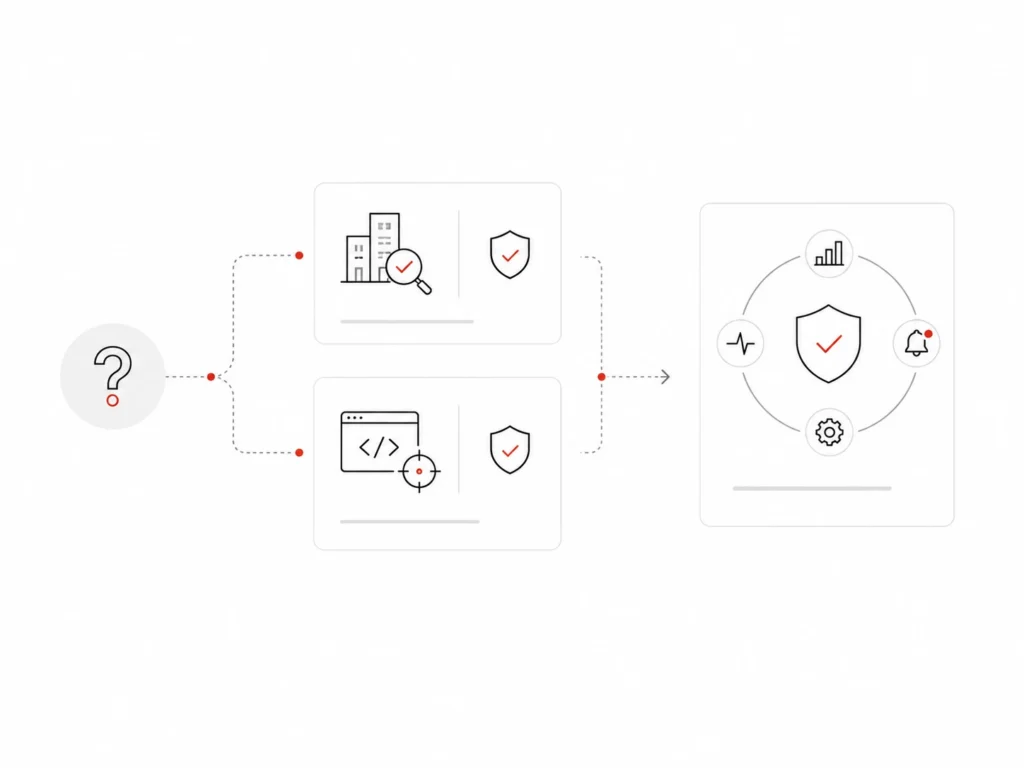
Not sure where to start?
Most clients start with a Company Security Audit (to see the full picture) or a Penetration Test (to test a specific product or system).
From there, many move to our continuous subscription — so security keeps pace with your business, not your calendar.

Book a free scoping call — we’ll recommend the right starting point in 30 minutes.

Business First
Code Next
Let’s talk
How we work

Scoping
We define goals, systems in scope, and rules of engagement together. Fixed price, no surprises.

Assessment
Senior specialists perform manual, hands-on testing and review, supported by tooling.

Prioritized reporting
An executive summary in business language plus technical findings with evidence, exploit paths, and step-by-step remediation guidance.

Remediation support
We work alongside your team (or as your team) to fix what we found.

Verification
Free retesting to confirm every fix actually closed the gap.
Why CodeIT

Manual-first
Real attackers aren’t scanners. Neither are we. Senior engineers on every engagement.

Findings You Can Act On
Every issue comes with evidence, business impact, and a fix — not a 200-page vulnerability dump.

We Stay Until It’s Fixed
Remediation support and retesting are part of the engagement, not an upsell.

Standards-based
OWASP, PTES, NIST, MITRE ATLAS; reporting mapped to ISO 27001, SOC 2, NIS2, DORA, PCI DSS, and the EU AI Act.

We Protect Your Data Like Our Own
ISO 27001, strict NDA and data-handling practices on every engagement.
FAQ
The cost depends on the service, scope, environment size, number of systems, and assessment depth. After a short scoping call, we provide a fixed-price proposal with clearly defined deliverables and no unexpected additions.
Timelines depend on the scope and complexity of the environment. Focused assessments may take a few weeks, while broader company-wide audits or multi-system engagements may require more time. The expected schedule is agreed during scoping.
Testing is planned around agreed rules of engagement to minimize operational risk. Where production testing is required, we define permitted techniques, testing windows, escalation contacts, and any systems or actions that must remain out of scope.
Yes, engagements can be covered by an NDA. Access to client data and assessment materials should be limited to authorized team members and handled according to agreed data-handling and retention procedures.
You receive an executive summary, detailed findings with supporting evidence, prioritized remediation guidance, and the deliverables defined for the selected service. Where included, we also provide remediation support, retesting, and a final verification report.