Digital Trends 2026

By 2026, technology strategy transforms fundamentally: companies shift from isolated innovations to building systems that are faster, safer, and structurally more resilient. AI becomes a natural part of product workflows, but it is only one element of a broader shift toward trust-by-design architectures, continuous security, and stricter regulatory expectations.
Infrastructure moves toward hybrid and region-specific models, shaped by data sovereignty and the global expansion of data centers. At the same time, the talent landscape changes: strong engineering expertise, AI literacy, and operational maturity become essentials, not differentiators.
Companies that succeed in 2026 will combine AI-enabled workflows, built-in security, modern infrastructure choices, and globally distributed talent into a unified execution model.
Why 2026 Is a Technological Turning Point
In 2023–2025, the adoption of artificial intelligence (AI) stops being “innovation for the sake of hype” and becomes a critical element of business operations. Since 2023, the share of companies that not only experiment but regularly use generative AI has been steadily growing.
According to a McKinsey & Company report, by 2024, 65% of organizations reported using GenAI in at least one business function almost twice as many as the year before. These are no longer pilots these are real operational workflows.
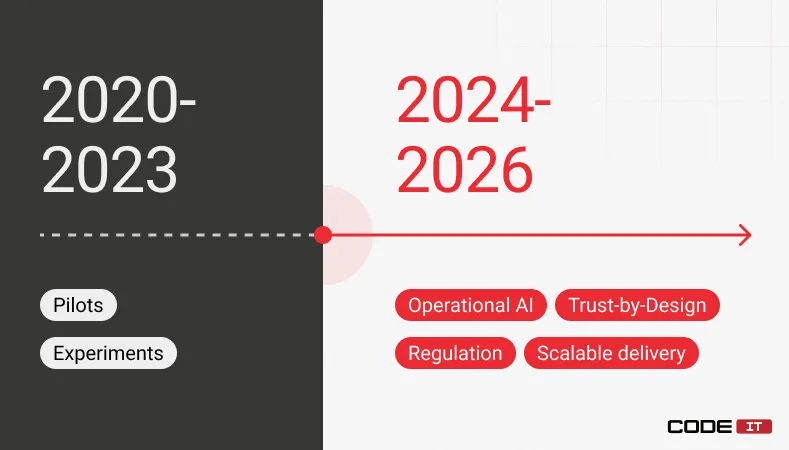
At the same time, regulatory and operational requirements intensify: security, compliance, explainability, and resilience become mandatory. Combined with accelerated demand for digital transformation, this creates a context where 2026 is viewed as a point of “setting one’s own standards,” rather than “catching up with competitors.”
The world is rapidly approaching a moment when AI moves from experimentation to full-scale systemic business transformation. According to McKinsey & Company’s “The State of AI in 2023: Generative AI’s Breakout Year”, about one-third of organizations reported they already use generative AI regularly in at least one business function. This means AI is no longer a niche add-on it is becoming part of the operating model. Companies that want to remain competitive now have to adapt.
Key Drivers Behind This Shift
- Speed of development and time-to-market
With advanced AI tools becoming widely accessible, traditional development cycles start to feel too slow. Markets increasingly expect new features, products, and updates to be delivered faster. AI helps accelerate development without compromising quality.
- Transparency and trust
As AI tools permeate business environments, the demand for explainability and clarity grows. Both developers and stakeholders, including regulators, expect AI-driven decisions to be understandable and traceable.
- Integration of AI into every layer of the business
AI is no longer treated as a separate experiment. It is becoming a foundational capability across product development, support, R&D, analytics, and DevOps.

Explore how these shifts apply to your product roadmap
Business First
Code Next
Let’s talk
Agentic AI: from a “tool” to a “digital workforce”
Agentic AI marks a shift from traditional generative models to systems that operate with a higher level of autonomy and contextual awareness. These agents can plan actions, execute multi-step workflows through APIs and tools, adapt their behavior in real time, and make task-level decisions independently. By 2024–2025, many organizations began viewing AI agents not just as assistants but as digital employees integrated directly into operational workflows.
What Agentic AI actually does
- Plans and sequences actions instead of producing isolated outputs.
- Executes tasks across tools, services, and APIs without manual intervention.
- Adjusts decisions and behavior based on context and feedback.
- Operates with autonomy at the task level, similar to a junior analyst or operator.
Where Agentic AI already creates value
- Operational workflows
Automation of routine tasks, incident triage, metric monitoring, and initial data processing, resulting in lower workload and faster response times.
- Business functions
Measurable gains in marketing, customer support, and back-office operations; Deloitte’s 2024 report highlights early ROI even when many implementations are still in pilot stages.
- Enterprise platforms
Integrated into decision support, content generation, analytics, and document management rather than used as isolated features.
What this means for engineering teams and outsourcing
- Automation of routine work
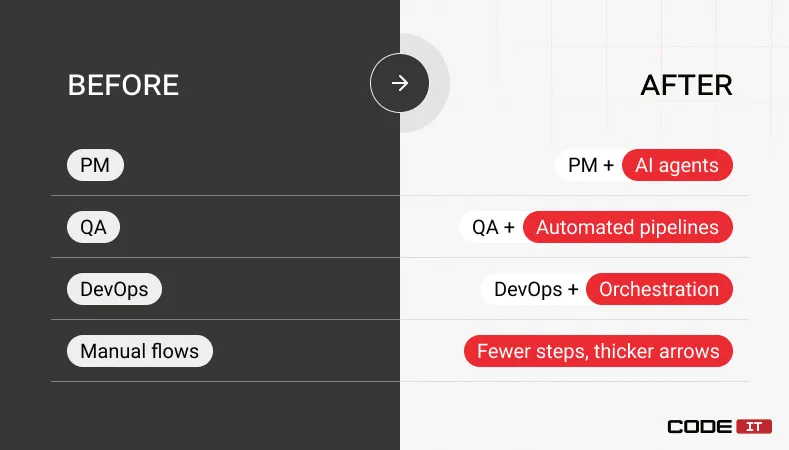
Parts of PM, QA, and DevOps activities can be delegated to agents, reducing dependency on headcount and increasing overall efficiency.
- Shift in outsourcing expectations
Clients increasingly want orchestrated ecosystems that combine people, agents, and processes—not just “hours and developers.”
- New talent requirements
Engineers must understand AI-driven workflows, demonstrate architectural thinking, and manage change in systems where AI is part of the operational loop.
DevSecOps as a Must-Have Capability
As AI-driven systems grow more complex, DevSecOps shifts from a “best practice” to a non-negotiable baseline. Modern organizations can no longer afford security as a late-stage activity; instead, protection, compliance, and auditability must be integrated directly into the delivery pipeline. This shift is reinforced by global standards and regulatory expectations, including ISO/IEC 27001, NIST guidelines, and the EU AI Act, which collectively require provable security, continuous monitoring, and full traceability across software systems.
Automated Security Checks as the New Normal
Modern DevSecOps pipelines rely on automation to reduce human error and accelerate detection. As recommended in industry best practices from OWASP and NIST, every commit, build, and deployment is expected to pass through multiple layers of automated checks.
Typical pipelines now include:
- SAST/DAST on every commit, static and dynamic analysis to detect vulnerabilities early.
- Automatic ticket creation when issues are found, eliminating the risk of “lost” or ignored findings.
- Continuous log and alert monitoring, often enhanced by AI agents capable of triaging incidents in real time.
- Dependency and container vulnerability scanning integrated into each build.
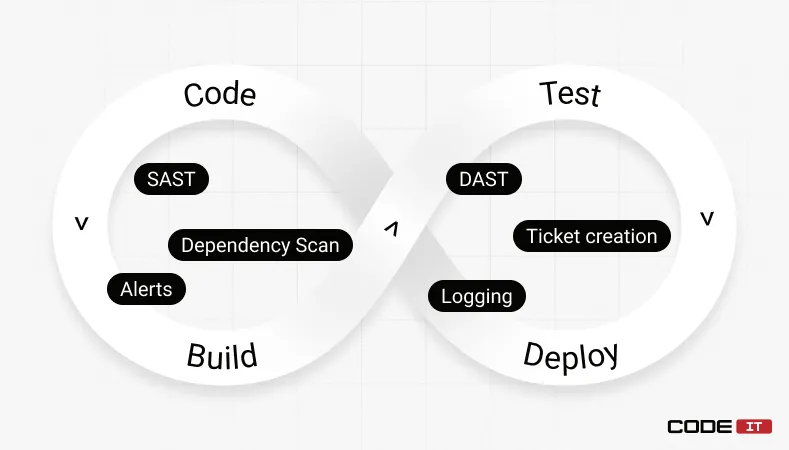
This is not a toolbox; it is a continuous security system. Automation shortens incident response time, reduces operational risk, and establishes a verifiable record of security compliance — a requirement increasingly enforced by regulators, auditors, and enterprise customers.
Compliance-by-Default Architecture
By 2026, software systems are expected to be built so that compliance is not an add-on but a structural property — “secure by default, compliant by design.” This aligns with international standards such as ISO/IEC 27001 and guidance from ENISA and NIST, which emphasize embedding governance controls directly into engineering workflows.
A compliance-by-default architecture typically includes:
- Secure pipeline templates, ensuring every project begins with correct access control, encryption, and audit settings.
- Automated security policies applied at build and deployment stages.
- Least-privilege access control enforced by default, not manually configured per team.
- CI/CD gates that halt deployment if any security checks fail.
This approach prevents the accumulation of “security debt,” stops risky exceptions from slipping into production, and ensures that every release is both audit-ready and regulation-aligned.
Evaluate your DevSecOps maturity
Business First
Code Next
Let’s talk
Trust by Design: why modern products must prove trust, not just claim it
“Trust by Design” has shifted from a trend to a requirement: security, transparency, ethics, and governance must be embedded from day one, not patched in later. Modern systems are expected to anticipate risks, explain decisions, maintain audit trails, and enforce strict access control. It’s no longer enough to say “our product is secure”—companies must prove it through certifications, transparent processes, and observable module behavior.
This applies directly to AI. The EU AI Act (2024) requires explainability and complete traceability for high-risk systems, making AI components auditable and accountable.
Source: European Parliament, 2024
Access management now follows the principle of least privilege: everything is forbidden unless explicitly required. These expectations are reinforced across ISO/IEC 27001:2022 and ISO/IEC 27701:2019, which define strict requirements for security controls, logging, and governance.
Trust must be engineered directly into the SDLC. Automated SAST/DAST checks, continuous logging, anomaly detection, and secure-by-default development patterns are what enable teams to deliver fast without compromising safety. This is the emerging “trust-speed paradox”: clients want immediate delivery, but also airtight security, compliance, certifications, and evidence before the first deployment.
Reports from McKinsey highlight this shift: organizations increasingly treat trust, security, and explainability as core differentiators rather than operational overhead.
While many consulting frameworks describe idealized automated trust pipelines, few organizations have implemented them fully. Yet demand continues to grow: businesses expect systems that correlate alerts, create tasks automatically, escalate anomalies, and use AI-driven logic to distinguish real issues from noise.
This isn’t a small process update, it’s a new industrial shift in how software is built. Companies that adopt Trust by Design early will gain a competitive advantage, while those relying on outdated practices will struggle to meet rising expectations.
Need help designing a Trust-by-Design architecture?
Business First
Code Next
Let’s talk
Regional Hubs as the Strategic Choice for 2026
Why regional hubs matter
By 2026, IT outsourcing is shifting from cost-driven offshore models to value-driven, collaboration-first Regional Hub partnerships. The rise of AI-driven product development, accelerated release cycles, and the need for tightly integrated distributed teams make them not just an alternative but the strategic default.
The rise of regional engineering hubs
The defining trend for 2025–2026 is the strengthening of regional engineering ecosystems — hubs with deep expertise, senior talent density, and mature delivery practices.
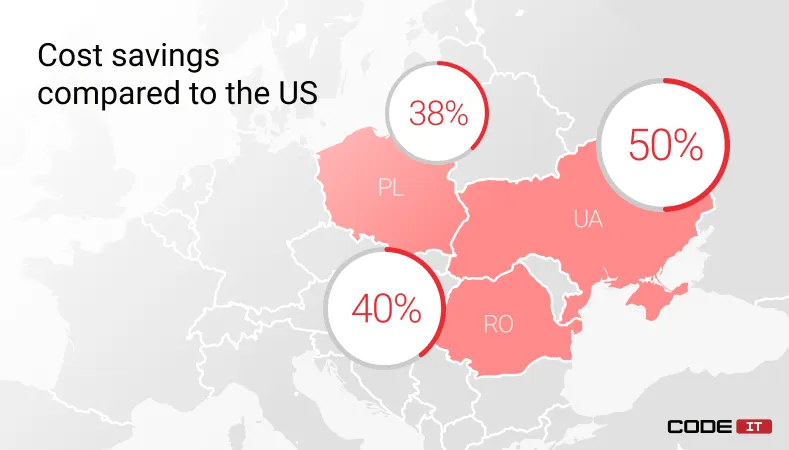
Eastern Europe
As noted in the Future of IT 2025 report (Alcor BPO), Eastern Europe remains one of the strongest regions for businesses due to its high engineering maturity, availability of strong middle/senior developers, and Western-aligned work culture.
Countries leading the cluster include Poland, Ukraine, Romania, Czech Republic and Lithuania.
Türkiye and the Middle East
These regions emerge as attractive options for European companies — combining geographic proximity, cost efficiency, and growing technical depth.
This global diversification allows businesses to assemble distributed engineering teams capable of delivering 18–20 hours of productive development per day without sacrificing coordination quality.
What this means for businesses in 2026
- Speed
Hubs support rapid iteration, real-time communication, and faster delivery cycles.
- Quality & stability
Mature engineering cultures, strong mid/senior talent pools, and solid DevSecOps practices reduce delivery risks.
- Scalability
Companies can expand teams quickly across regional hubs without compromising communication or governance.
- Cost-to-value balance
Regional hubs offer a mature, high-performance delivery ecosystem, optimized for predictability, speed, and consistently strong engineering output.
For organizations building AI-heavy, compliance-sensitive, or mission-critical digital products, regional hubs are not merely an outsourcing option — they are a core part of modern engineering strategy.
The Road to 2026: How Businesses Should Shape Their Strategies Today
1. Treat AI adoption as a systemic transformation, not a “pilot ± luck” experiment
Companies that succeed with generative AI typically:
- Integrate AI across multiple functions simultaneously (marketing, IT, operations)
- Build their own or customized models instead of relying exclusively on off-the-shelf solutions
- Design governance, security, and control frameworks in parallel with technical implementation.
2. Implement DevSecOps and embrace “security by default”
Security, transparency, and control are becoming essential competitive advantages. Architectures that lack logging, auditability, and human-in-the-loop oversight lose credibility already at the negotiation stage.
3. Use engineering hubs for flexibility and cost-effective scaling
Regional engineering hubs have become a strategic way to scale capabilities quickly, accelerate product delivery, and maintain operational control without compromising quality or compliance. Their time-zone proximity, senior talent density, and alignment with industry standards make them especially valuable for European organizations that require fast iteration cycles, predictable execution, and culturally compatible collaboration.
4. Invest in talent capable of operating in the new AI-driven environment
Strong engineers who combine technical expertise with business thinking and AI literacy are becoming invaluable. HR strategies, value propositions, and retention models must evolve to attract and retain such specialists.
Conclusion
By 2026, AI-driven transformation will no longer be optional — it becomes a defining feature of how competitive organizations operate. Companies that move beyond pilots and embrace AI as a structural capability will pull ahead, while those who delay will struggle to keep pace with rising expectations for speed, transparency, and operational excellence.
Agentic AI fundamentally reshapes work itself: tasks once handled manually now flow through autonomous digital agents that support engineering, operations, and business teams. This shift elevates the importance of governance, trust, and robust security practices. As adoption increases, clients, regulators, and investors expect clear auditability, responsible AI policies, and architectures that can be explained, not just executed.
The global talent landscape is also changing. Access to skilled engineers becomes a core competitive factor, driving organizations toward development hub models that offer proximity, scalability, and compliance without compromising on quality. Meanwhile, internal teams must evolve: the most valuable specialists are those who combine engineering expertise with business reasoning and AI fluency.
Ultimately, the winners of 2026 will be the companies that:
- Embed AI across multiple business functions
- Design secure, transparent systems from day one,
- Scale through flexible local hubs ecosystems
- Invest in people capable of navigating an AI-augmented environment.
The transformation is already underway. The question for every organization is no longer whether to adopt AI at scale — but how quickly and strategically they can make it a core part of their operating model.
Related Articles

AI Chatbots in Healthcare: Conversational Cure for Your Business