
Low-Code Platform for Manufacturing Operations
Industry
Manufacturing
Location
USA
Team size
5
Project information
Overview
A large North American packaging manufacturer serving foodservice and retail industries operated on a core of custom-built, pro-code applications that could no longer scale with growing production and distribution demands. High maintenance overhead, fragmented user experiences, and the absence of a unified platform strategy slowed delivery and increased cost of ownership.
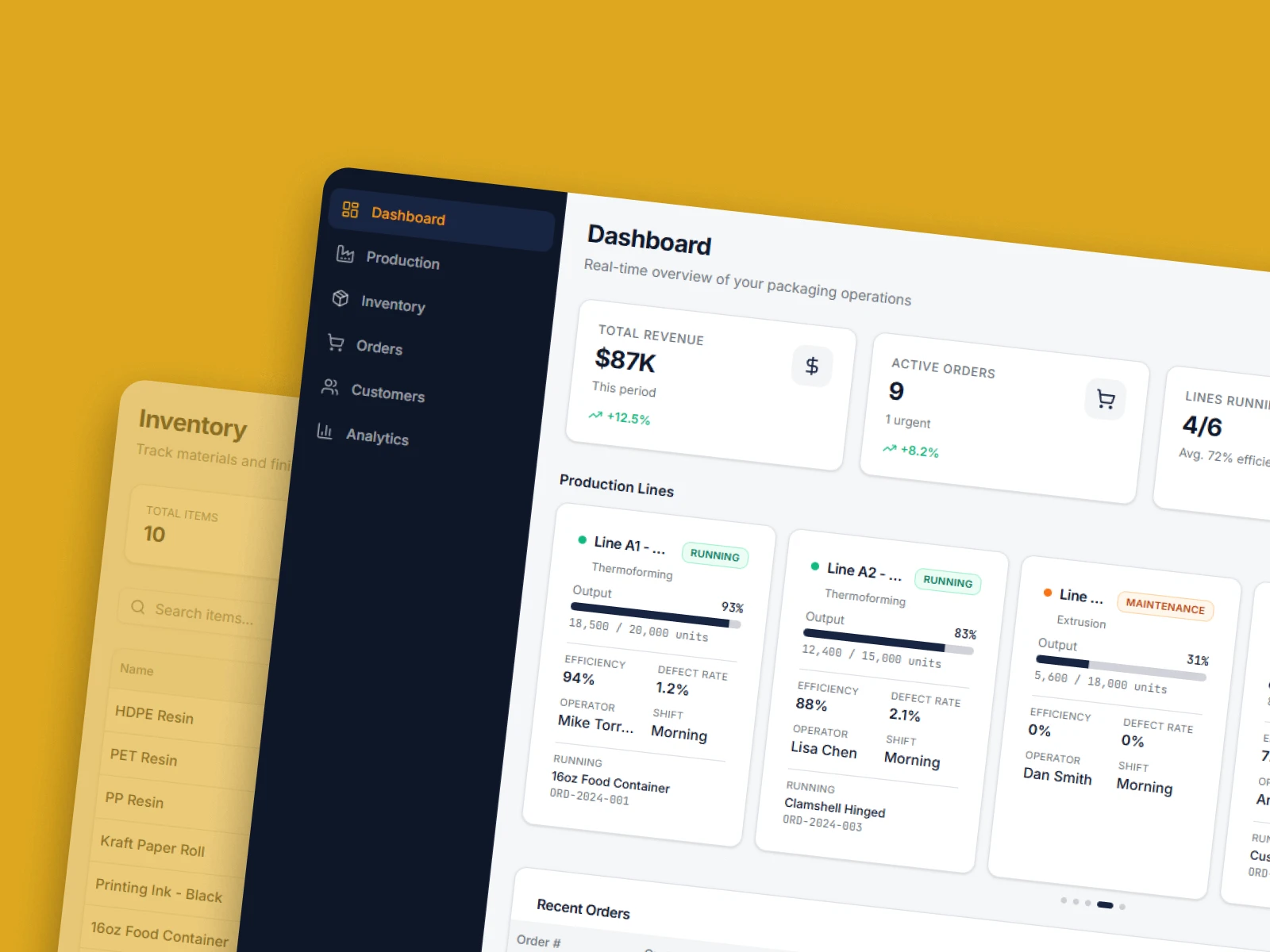
CodeIT modernized the technology baseline by introducing a governed low-code platform built on Microsoft Power Platform — standardizing application development, automating key processes, and reducing dependency on custom engineering across business units.

Challenge
Legacy Custom Architecture
Core applications were built as custom pro-code solutions, making changes costly and slowing down feature delivery cycles.
Limited Scalability
Existing architecture lacked flexibility to scale with growing operational and production demands across business units.
High Maintenance Overhead
Custom-developed systems required continuous engineering effort, increasing cost of ownership and slowing innovation.
Lack of Unified Platform Strategy
Absence of a centralized platform led to inconsistent tools, duplicated logic, and fragmented user experiences.
Implementation

Discovery & Architecture
Conducted a structured discovery phase to assess the existing application landscape and define the target low-code architecture. Designed a migration roadmap prioritizing core business applications and governance setup.

Power Platform Foundation
Established Power Platform as the core enterprise layer to standardize application development and reduce reliance on pro-code engineering across teams.

Application Rebuild
Rebuilt core business applications using canvas apps to align with real operational workflows and improve usability across production and distribution teams.

Process Automation
Implemented Power Automate workflows to replace manual operations and streamline business processes across departments.

Governance Setup
Deployed the Microsoft CoE framework to control environments, enforce development standards, and enable scalable and secure platform adoption.
Business Value
Reduced Pro-Code Dependency
Shift to low-code reduced reliance on custom development and improved adaptability of business applications.
Lower Cost of Ownership
Standardized platform eliminated redundant development and reduced maintenance effort across systems.
Faster Tool Access for Teams
Business teams gained faster access to new internal tools, reducing time-to-market for process updates.
Consistent User Experience
Unified platform standardized interfaces and workflows, improving adoption and reducing training effort.
Scalable Governance Model
CoE framework enforced environment standards, enabling controlled and secure platform expansion.
Accelerated Innovation Cycles
Low-code foundation reduced time from idea to deployment, enabling faster response to operational changes.
Results
Lower maintenance effort
30–40%
Lower development costs
20–30%
More process automation
40–60%
Technology stack
- Microsoft Power Platform
- Canvas Apps
- Power Automate
- Microsoft CoE Toolkit
Team
- Enterprise Architect
- Governance Architect
- Delivery Manager
- Dynamics 365 Engineers
- Power Platform Engineers